

Smallest suitable drum
From a manufacturer's returnable wooden drums – by length and weight. Or choose a drum, or enter your own dimensions.
Diameter, weight and length of the cable are enough: the tool finds the smallest suitable drum from the manufacturer's table and gives layers, turns, capacity and the weight that crane and vehicle have to carry.
Register for free Read more in the manual
1 location free, no payment details. Runs in the browser – nothing to install. Try it without registering
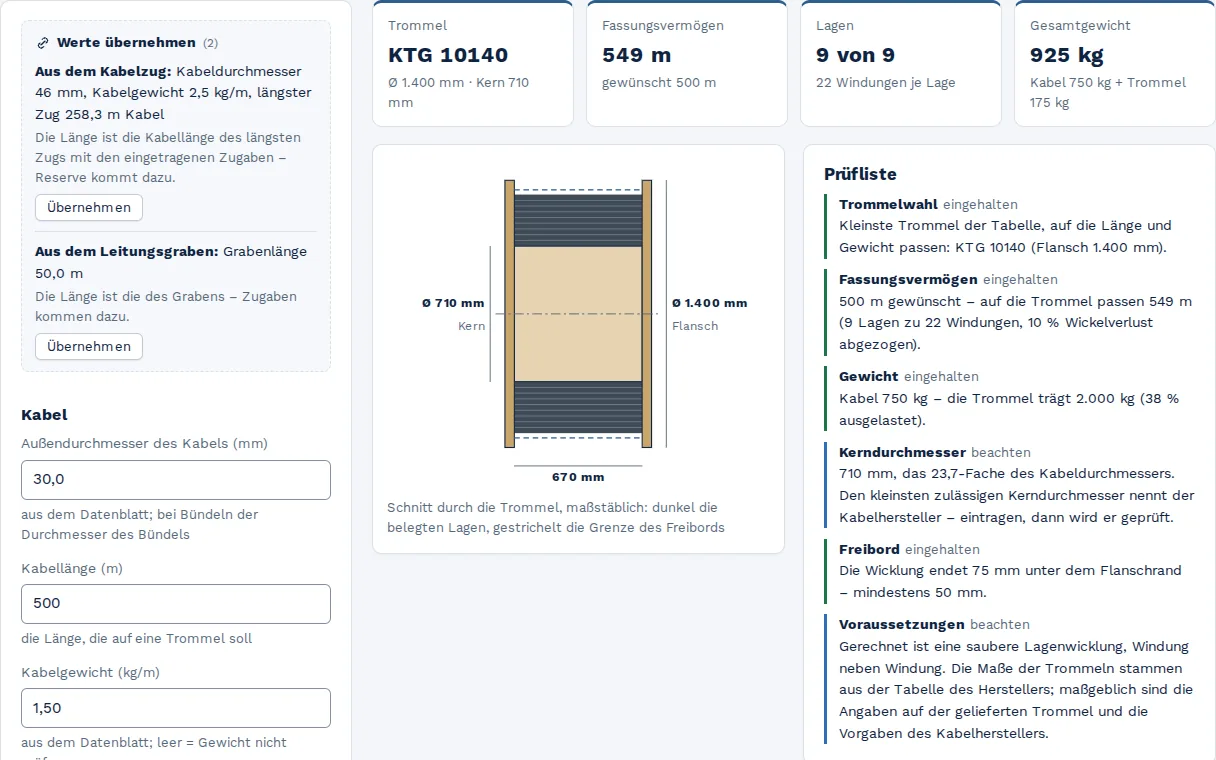
From a manufacturer's returnable wooden drums – by length and weight. Or choose a drum, or enter your own dimensions.
Turns per layer, used and possible layers, length by geometry and with winding loss.
Cable plus empty drum, against the load capacity of the drum – for crane, drum trailer and vehicle.
For your cable: which drum fits, which is too small, which cannot carry the weight.
The formula for the length is pure geometry. The drum table lists a manufacturer's returnable wooden drums as published – the table with its date is in the manual. Go to the chapter in the manual
500 m of cable, 30 mm thick, 1.5 kg/m – smallest suitable drum. The figures are calculated by the same engine as in the application – when this page is opened.
| Quantity | Result | Calculation |
|---|---|---|
| Drum | KTG 10140 | flange 1,400 mm, core 710 mm, traverse width 670 mm |
| Turns per layer | 22 | 670 ÷ 30, rounded down |
| Layers | 9 of 9 | used of possible |
| Length by geometry | 609.6 m | π · 22 · 9 · (710 + 9 · 30) mm |
| Capacity | 548.6 m | 609.6 · (1 − 0.10) |
| Total weight | 925 kg | 500 · 1.5 + 175 |
| Load capacity used | 38 % | 750 kg ÷ 2,000 kg |
The next smaller drum does not take the cable – the comparison of all drums is shown in the calculator.
No login, nothing saved: enter values, and the result is calculated by the same engine as in the application.
Calculated with 50 mm flange clearance and 10 % winding loss, smallest suitable drum from the table. In a project: fixed drum or own dimensions, section, comparison of all drums, comparison with the cable pull.
What the tool does not do – so that it is clear what the result is good for. Results are planning aids, not construction documents.
That depends on flange, core, traverse width and the cable diameter. Drum 10140 (flange 1,400 mm) takes 609.6 m of a 30 mm cable by geometry, 548.6 m with 10 % winding loss.
Yes – flange and core diameter, traverse width, weight of the empty drum and load capacity, for instance for steel drums or other manufacturers.
Yes, the geometry is the same. At the location the tool offers diameter, weight and length from the calculated span for transfer.
All tools work at the same location with the same coordinate – what is created in one is available in the next.
One location free, all tools. No credit card, no subscription.
Register for free